Creatine, Brain Function, and Regenerative Medicine: What the Research Suggests
Creatine is usually associated with gym performance and muscle recovery, but it also plays an important role in the brain. While many people know creatine as a sports supplement, researchers have also studied it for its possible effects on memory, mental performance, brain energy supply, and healthy aging.
A systematic review published in Experimental Gerontology looked at randomized controlled trials on creatine supplementation in healthy individuals and found that oral creatine may improve short-term memory and intelligence/reasoning, while results for other cognitive functions were mixed or unclear. The review also suggested that creatine may be more relevant for aging or stressed individuals than for healthy young adults. Effects of creatine supplementation on cognitive function of healthy individuals: A systematic review of randomized controlled trials
That makes creatine an interesting topic not just in sports medicine, but also in broader conversations around healthy aging, brain function, and regenerative medicine. Still, it is important to stay realistic. Creatine is not a proven cure for dementia, cognitive decline, or neurodegenerative disease. What the research suggests is that creatine may help support cellular energy systems and neuroprotection, which is why it continues to attract interest in brain health research.
What is creatine?
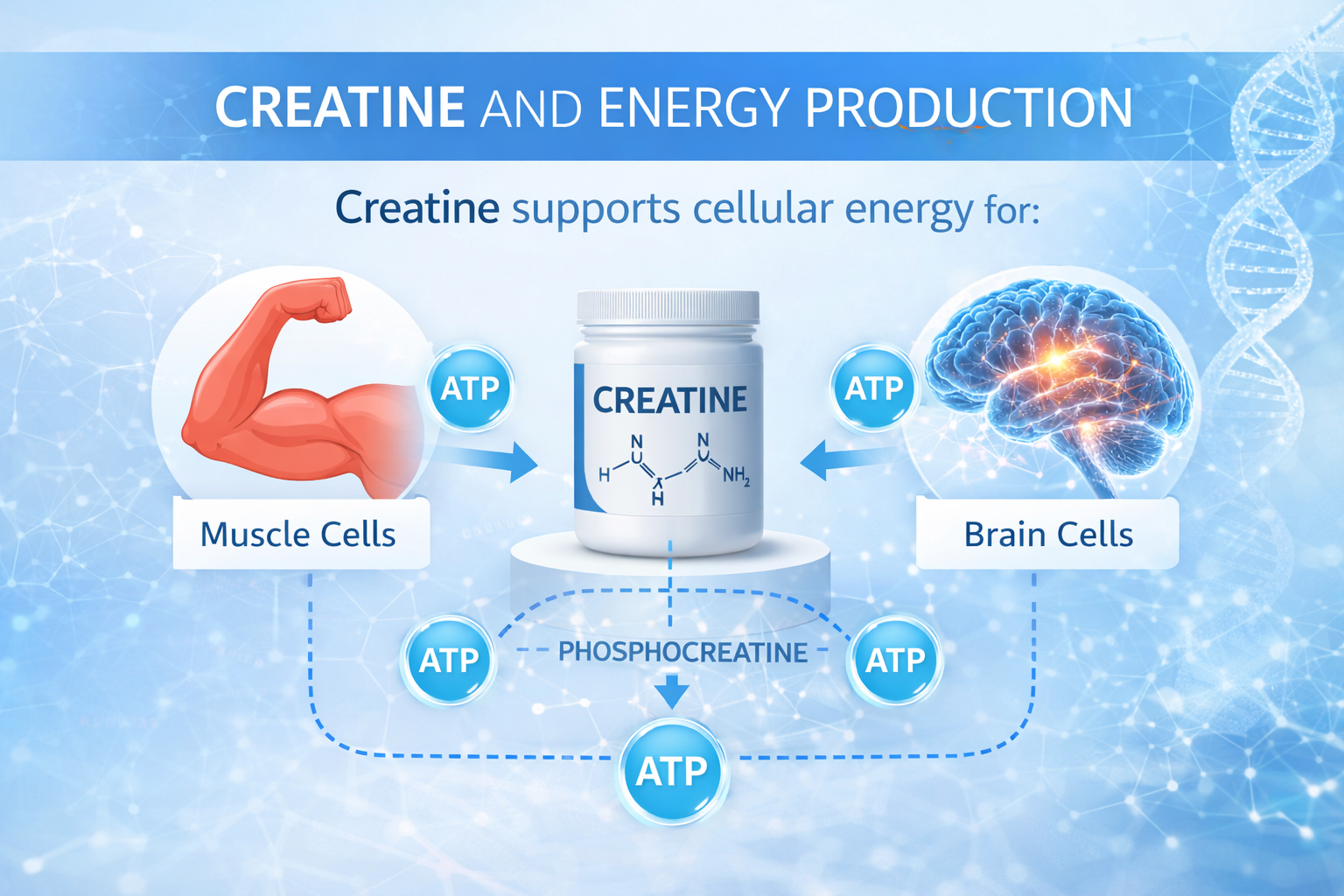
Creatine is a naturally occurring compound made from the amino acids arginine, glycine, and methionine. Its main role is to help tissues with high energy demands rapidly regenerate ATP, the body’s main cellular energy source. This is especially important in tissues like muscle and brain, where energy demand can rise quickly.
In simple terms, creatine acts like part of the body’s fast energy support system. That is why it became popular in athletic performance, but it is also why researchers have looked at its role in brain metabolism and cognitive resilience.
Why are researchers interested in creatine and brain function?
The brain requires a huge amount of energy to function properly. Neurons rely on stable energy production for memory, concentration, signaling, and normal cognitive performance. Because creatine helps support cellular energy balance, researchers have explored whether it might improve cognition or support the brain during periods of stress, aging, sleep deprivation, or metabolic strain
The review also explains that creatine may have a role in neuronal plasticity and possible neuroprotection. In addition, genetic creatine disorders can cause significant neurological and developmental problems, which highlights how important normal creatine pathways are for brain function.
This is where creatine starts to overlap with conversations about regenerative medicine. Not because it has been proven to regenerate damaged brain tissue in a clinical setting, but because regenerative medicine also looks at ways to support recovery, cellular resilience, energy metabolism, and repair environments.
What did the systematic review find?
The review identified six randomized controlled trials involving 281 healthy individuals. Overall, the strongest signal was that creatine may improve short-term memory and intelligence/reasoning, while results for other areas such as attention, executive function, reaction time, mental fatigue, and long-term memory were either conflicting or unclear.
Some of the main findings included:
possible improvement in short-term memory
possible improvement in intelligence or reasoning tasks
better response in some vegetarians during memory tasks
little or no clear benefit in healthy young adults
generally minor side effects in the studies that reported them
This is important because it suggests creatine may not act like a universal “brain booster” for everyone. Instead, it may be more helpful in situations where energy support is more relevant, such as aging, stress, or lower baseline creatine availability.
What does this mean for regenerative medicine?
It is best to be careful with the term regenerative medicine here. Creatine is not a proven regenerative medicine treatment in the same category as stem cell procedures or established tissue-repair interventions. But it does fit into a broader discussion around supportive recovery biology.
The research suggests creatine may help with:
rapid ATP replenishment
support for tissues with high and fluctuating energy demands
possible neuroprotective effects
support during aging or physiological stress
That does not prove regeneration, but it does support the idea that creatine may contribute to a more favorable environment for cellular function. In clinical wellness terms, it may be more accurate to describe creatine as a supportive compound rather than a regenerative therapy.
Who may benefit the most?
The review suggests creatine may be more useful in:
older adults
people under physical or mental stress
individuals with higher energetic demands
possibly some people with lower dietary creatine intake, such as vegetarians
Interestingly, several studies found that healthy young adults showed little or no improvement after supplementation. That supports the idea that creatine may be more relevant where there is a meaningful energy-related limitation, rather than as a universal cognitive enhancer.
For a Bali-based clinic audience, this makes creatine most interesting in conversations about:
healthy aging
recovery after illness or travel
nutritional support
evidence-based wellness planning
What are the limits of the evidence?
This is one of the most important parts of the conversation.
The review is useful, but the evidence base was still limited. The included studies were relatively small, used different doses and treatment durations, and tested different cognitive tasks. Some studies also had unclear or higher risk of bias. Because of this heterogeneity, the authors did not perform a meta-analysis.
That means the findings are promising, but not definitive.
The most honest takeaway is:
creatine shows potential
it appears generally safe in standard supplemental use for most healthy people
it may help some cognitive functions in certain groups
but it is not yet a proven medical treatment for cognitive decline, dementia, or neurodegenerative disease
Is creatine safe?
In the studies included in the review, reported side effects were generally minor, including issues like bloating and headache, and these were not significantly different from placebo in the study that reported them.
Still, “generally safe” does not mean it is suitable for absolutely everyone without review. Older adults, people with kidney issues, those taking multiple medications, or people with other significant medical conditions should speak with a doctor before starting supplements regularly.
This is especially relevant in Bali, where travel, heat, dehydration, stomach illness, and low food intake can all complicate supplement use. A product that is safe in theory may not be appropriate in the wrong situation.
What this means for patients in Bali
For Revive Medical Bali, the practical value of this topic is not about marketing a miracle supplement. It is a reminder that brain function, healthy aging, and recovery are closely connected to energy metabolism, nutrition, hydration, sleep, and medical assessment.
Creatine may be worth discussing for:
older adults focused on healthy aging
people recovering from stress or poor intake
patients interested in evidence-based wellness support
those asking about supplements for cognitive resilience
But it should be discussed realistically. It is one piece of a much bigger picture that includes:
proper hydration
adequate nutrition
sleep
movement
managing illness early
checking for underlying medical issues when symptoms persist

Final thoughts
The research suggests that creatine is more than just a sports supplement. It plays a real biological role in the brain and may help support short-term memory and reasoning, particularly in older or stressed individuals. That makes it relevant to conversations around brain energy, healthy aging, and supportive regenerative medicine concepts.
But the key word is supportive. Creatine is not a magic fix, not a proven brain-regeneration therapy, and not a replacement for good food, hydration, sleep, and medical care.
For people in Bali thinking more seriously about wellness, recovery, or healthy aging, the best approach is still a practical one: understand the evidence, stay realistic, and build from the basics.